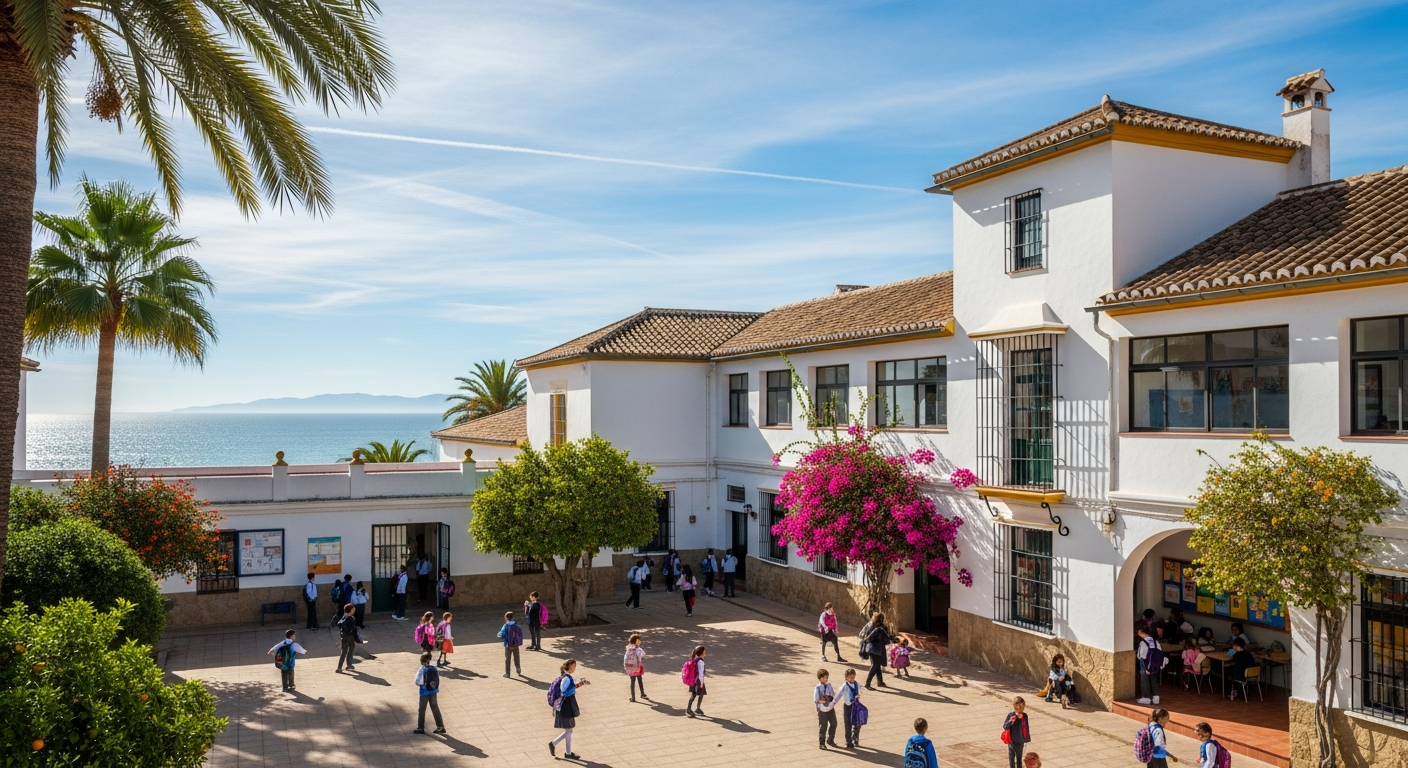
For families relocating to southern Spain, choosing the right school is often the first big decision. Here is a clear guide to private school fees, facilities and the admissions process on the Costa del Sol.
For international families settling on the Costa del Sol, few decisions matter more than schooling. The right school shapes not only a child's education but often the neighbourhood a family chooses to live in. This guide to private school Costa del Sol tuition fees and admissions is designed to help you weigh curricula, costs, facilities and timelines with confidence — whether you are relocating for work, lifestyle or a change of pace.
Why so many families choose private and international schools
The Costa del Sol has one of the largest concentrations of international schools in mainland Spain, reflecting its long-established community of foreign residents. For families who plan to stay a few years, or who want their children to continue in a familiar curriculum, private and international schools offer continuity, English-language instruction and internationally recognised qualifications.
Most private schools in the region fall into three broad camps: British-curriculum schools leading to IGCSE and A-Levels, schools offering the International Baccalaureate (IB), and Spanish or bilingual private schools that follow the national curriculum with strong language provision. Some larger schools blend more than one pathway, allowing children to switch tracks as they progress.
Matching the curriculum to your plans
Before comparing prices, think about your family's horizon. If you expect to move on within a few years, a school offering the same curriculum as your home country eases the eventual transition. If you intend to stay long-term and want your children fully integrated — and fluent in Spanish — a bilingual school may serve them better. The IB is a popular middle path for globally mobile families, as it is widely recognised by universities worldwide.
Understanding tuition fees
Tuition is the headline figure, but rarely the whole story. Fees vary considerably by school, year group and curriculum, and they typically rise as children move from early years through to the final school years. Rather than quoting figures that change annually, it is wiser to budget across several categories and request the current schedule directly from each school.
The costs beyond tuition
When you request a fee schedule, ask specifically about:
- Registration and enrolment fees — usually one-off and payable on acceptance of a place.
- A refundable or non-refundable deposit to secure the place.
- Annual capital or development levies that some schools charge in addition to tuition.
- Uniform, books, technology and materials, which can be significant in the early years.
- Transport if the school runs bus routes, which many do given the spread-out geography.
- Extracurricular activities, trips and exam-entry fees, particularly at IGCSE, A-Level and IB stages.
- Lunch and catering, sometimes bundled and sometimes billed separately.
Many schools offer sibling discounts or a modest reduction for paying annually rather than termly. It is always worth asking, as these policies are not always published.
Assessing facilities and teaching quality
Glossy prospectuses can make every school look identical. A visit tells you far more. When you tour, look past the marketing and pay attention to the everyday details: the condition of classrooms, the ratio of adults to children, the atmosphere in corridors and how pupils speak about their teachers.
What to look for on a school visit
- Class sizes and staff retention — high teacher turnover can be a red flag.
- Sports and outdoor space, which is often generous given the climate; many schools have pools, pitches and tennis facilities.
- Science labs, arts studios and technology provision appropriate to the ages taught.
- Learning support and provision for additional needs, including English as an Additional Language for children arriving without Spanish or English fluency.
- Pastoral care and settling-in support for new arrivals mid-year.
- University and careers guidance at senior schools, and where recent leavers have gone on to study.
Ask to speak with current parents if you can. Their candid impressions of communication, community and how the school handles problems are invaluable.
The admissions process, step by step
Admissions on the Costa del Sol tend to be more flexible than in some countries, partly because families arrive throughout the year. Still, popular schools and year groups fill up, so early contact matters.
- Enquire and register interest with your shortlisted schools as early as possible.
- Tour the school and meet admissions and, ideally, teaching staff.
- Submit an application with supporting documents — typically previous school reports, references and identification. Older applicants may sit an entrance assessment or have an interview.
- Receive an offer and pay the deposit and registration fee to secure the place.
- Complete enrolment, submit medical and residency paperwork and arrange transport, uniform and any assessments for learning support.
Because places in certain year groups can be limited, it is sensible to apply to more than one school. If you are moving mid-academic-year, ask directly about availability rather than assuming a place exists.
Documents and language considerations
Spanish schools may request officially translated and, in some cases, legalised documents. Build in time for this, as translation and apostille processes are not instant. If your child has no Spanish, ask each school how it supports newcomers and how quickly children typically settle.
Location: schools shape where families live
One of the most practical realities of school choice is commuting. School-run traffic along the coast can be heavy, so many families choose a home within a comfortable radius of their chosen school. This is why school catchment quietly influences the property market in several areas.
Families drawn to established residential communities often explore Nueva Andalucía and the wider Marbella area, which sit within easy reach of several international schools and offer a mix of villas, townhouses and apartments suited to family life. Further west, Sotogrande is a genuinely school-centred community, planned around family living with generous green space and a calm, residential rhythm.
When you begin viewing homes, factor the daily drive to and from school into your shortlist just as you would proximity to the beach or the airport. A ten-minute difference each way adds up over a school year.
On the market now:
€1,350,000 — Los Naranjos Marbella apartment. View listing — three bedrooms, three baths, in the Nueva Andalucía school catchment most families ask for first.
€2,031,000 — Detached Villa, Sotogrande. View listing — four bedrooms, four baths, inside the coast's most deliberately family- and school-centred community.
Timing your move
The academic year in Spain generally runs from September to June. Applying in the spring for a September start gives you the widest choice of places and time to arrange documents, housing and transport. That said, schools do accept mid-year arrivals, and moving in, say, January can even mean less competition for places in some year groups. If your relocation timeline is flexible, aligning it with the school calendar reduces disruption for children.
Bringing it together
Choosing a school is really a series of connected decisions: curriculum, budget, facilities, admissions timing and, ultimately, where you live. Approach it in that order. Start with the education you want for your children, verify the full cost — not just the tuition line — visit in person, and only then let the school anchor your property search. Handled thoughtfully, the process becomes far less daunting, and you arrive knowing both your children and your household are well placed for the move ahead.